← Back


CHALLENGE
Bolstering Community Flood Resilience
New York's stormwater infrastructure has not kept pace with its rainfall. In October 2025, when I heard two people drowned in the flash floods, I kept wondering: how can we be better prepared next time? In the recent past, Hurricane Ida and the flash flooding around it killed fifteen New Yorkers, thirteen of them in basement apartments, concentrated in environmental justice communities. Between storms, the risk becomes invisible again. No public memory carries forward to the next storm, which means each one arrives as a surprise to the people least able to absorb it This project aims to advance understanding of how designed environments can support collective adaptation and inform pathways for integrating community-led climate resilience into municipal planning practice
Client
Proposal for Design Trust for Public Space
Location
New York City
Year
2026
“Block Flood Guardians” investigates street flooding mortality as a crisis of spatial legibility and social infrastructure in neighborhoods experiencing climate vulnerability The proposal envisions two interdependent forms of community flood resilience infrastructure: site-specific placemaking embedding flood memory and preparedness into everyday public space, and trained residential networks bridging gaps in maintenance and emergency coordination
THEMES
climate resilience · social infrastructure · placemaking · community engagement · policy advisory · public life
HIGHLIGHTS

01
Two kinds of guardians, doing different work
Place guardians are physical: art installations, transit stop exhibitions, activated storefronts, and flood-height markers that make invisible risk legible and link directly to emergency resources. People guardians are a Block Flood Corps, trained residents who clear catch basins, maintain confidential lists of basement households for targeted alerts, and stay connected to city resources. Neither works alone. A marker without a network is a plaque; a network without visible cues has nothing to organize around

02
Remember, Prepare, Respond
Before a flood, installations build awareness and the Corps does maintenance. During one, the Corps runs wellness checks on vulnerable residents and clears drains, while activated storefronts become coordination hubs within walking distance. After, the installations become memory keepers and the Corps documents service failures and infrastructure gaps, generating the record that supports advocacy. The same infrastructure does different work in each phase, which is what makes it worth building

03
Block scale, Citywide Language
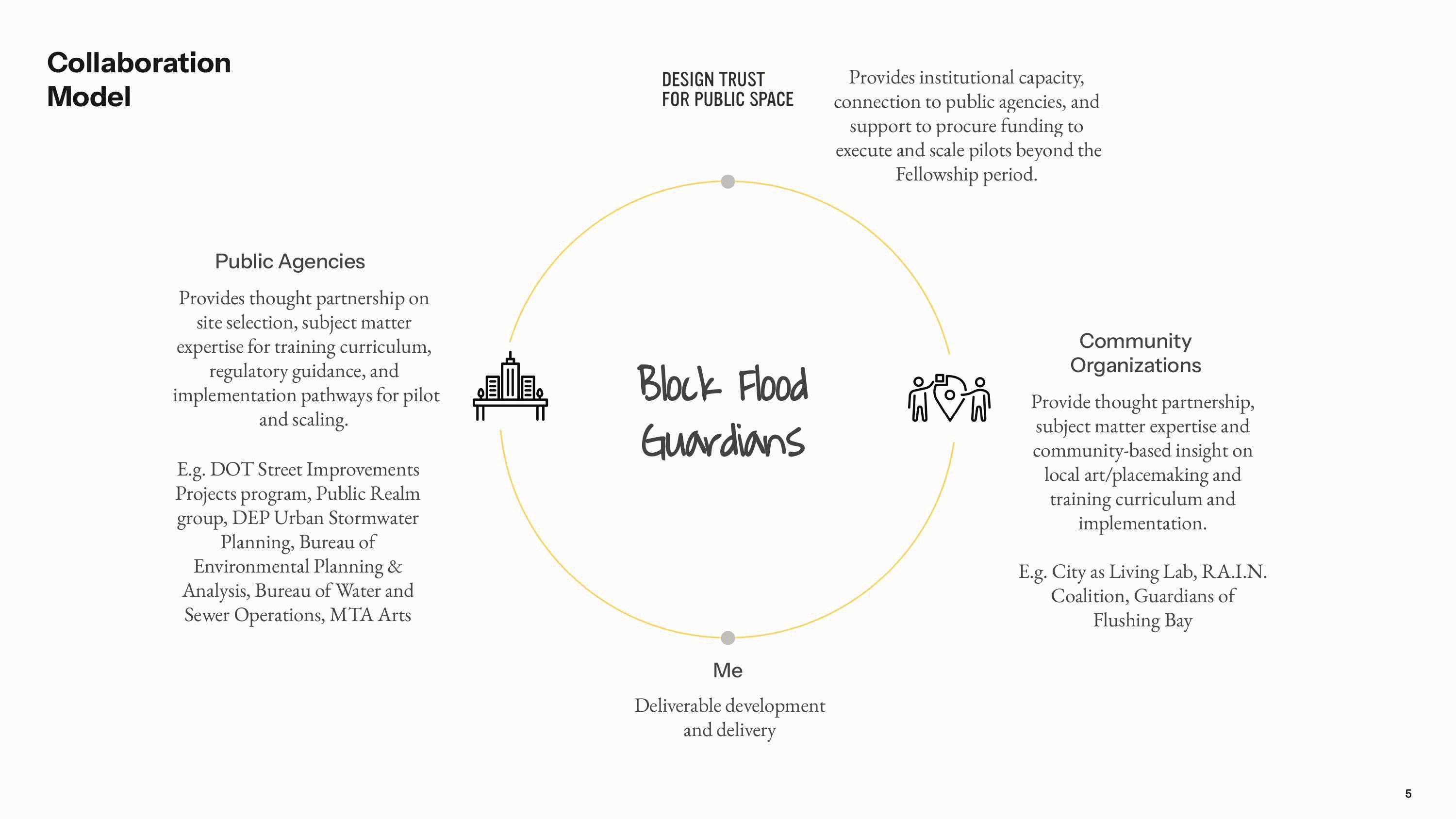
Two outputs over nine months: a scalable creative placemaking toolkit and a Block Flood Corps program framework, structured across Discover, Design, Pilot, and Scale phases. Both were framed as instruments for building buy-in and securing funding for later phases rather than as finished programs, with a collaboration model positioning Design Trust, public agencies including DOT, DEP, and MTA Arts, and community organizations each in defined roles
Great minds think alike -- we're so glad the City's investing in catch basin infrastructure! Announced soon after this proposal was submitted to Design Trust That said, our underlying argument remains an active area of interest: that the gap between household preparedness and municipal capacity is a problem we can design for, and that the block is the right scale to close the gap Reach out if you're interested in collaborating!

Say hello. Let's make magic ↗
← Back