← Back



CHALLENGE
Change Management Strategy for a Global HQ Renovation
A global organization undertaking a first-floor renovation of its regional headquarters faced a challenge that most workplace projects underestimate: the physical transformation was the smallest part of the change. With 800 employees displaced into temporary swing space for nine months and a new unassigned seating model waiting for them on the other side, the project carried real organizational risk Without a structured approach to the human side of the transition, the business faced productivity loss during disruption, a capital investment that employees wouldn't use as intended, and the kind of eroded trust in leadership that outlasts any renovation
Client
Confidential Proposal
Location
N/A
Year
2026
My proposal built on my past experience in workplace strategy: employees who feel heard and cared for during disruption arrive at a new space with higher trust and greater readiness to adopt change The approach drew on Prosci's three-phase process (Prepare, Manage, Sustain) as the organizational backbone, and used ADKAR (Awareness, Desire, Knowledge, Ability, Reinforcement) to guide individual employees along the adoption journey with targeted interventions McKinsey's 7-S provided a framework to incorporate both hard elements of the change (strategy, structure, systems) and the soft ones (shared values, style, skills)
THEMES
organizational change management · workplace strategy · future of work
HIGHLIGHTS

01
Leverage the swing space as an opportunity
Reframed the swing space from a logistical inconvenience into the primary change management asset: a nine-month window to build familiarity, test new behaviors, and arrive at the destination space with readiness rather than resistance

02
Align change management with design phases
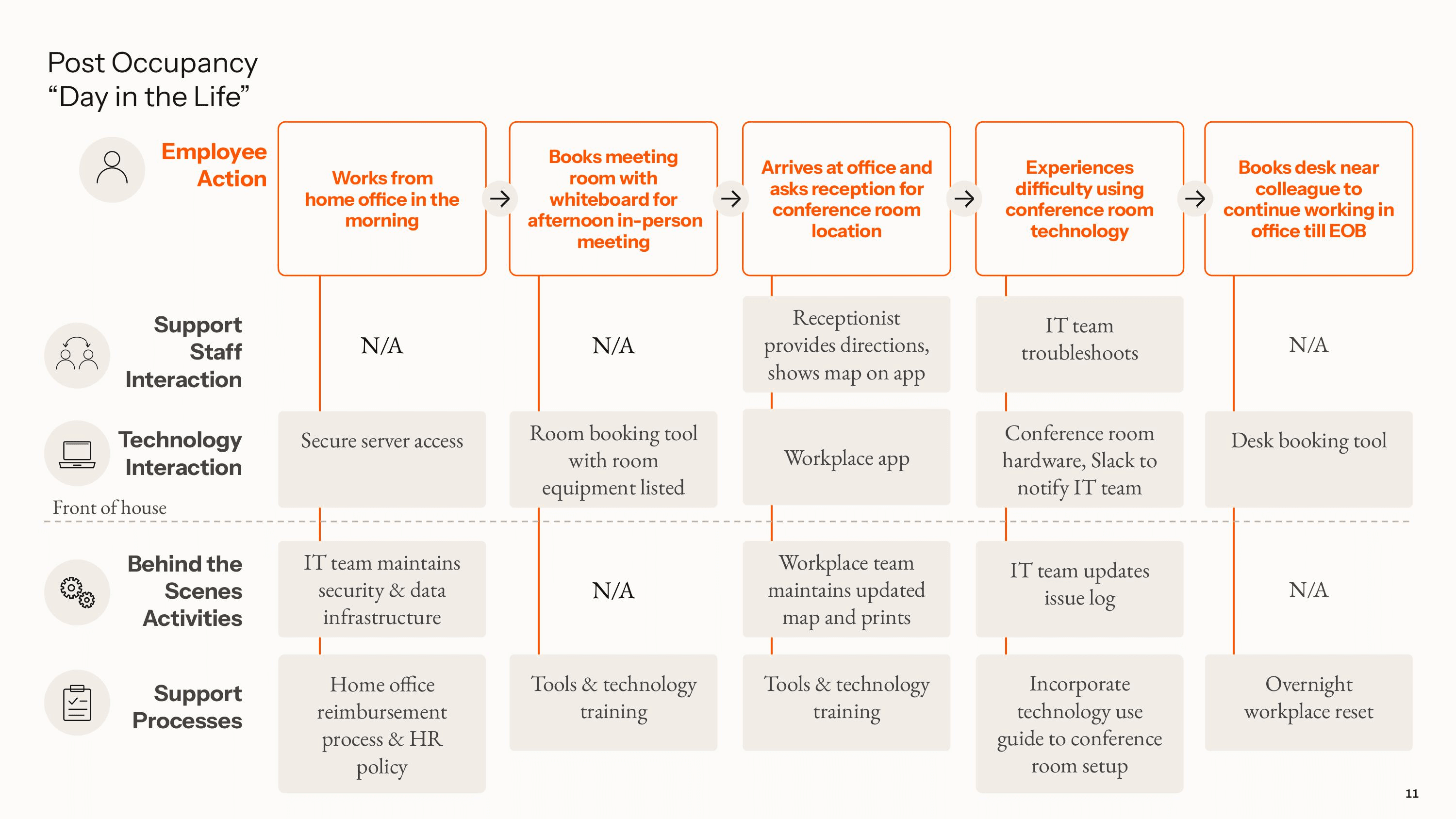
Developed a four-phase delivery model spanning workplace discovery through post-occupancy, with change management running in parallel to design and construction rather than following it, ensuring employee feedback could still influence design decisions before they were locked

03
Build stakeholder management and accountability into the structure
My proposal activated a multi-tier stakeholder model: a steering committee to hold executive accountability, a cross-functional implementation committee spanning IT, HR, Facilities, and Communications to manage operational dependencies, and a change champion network embedded in the employee population to sustain ongoing dialogue and surface friction before it hardened into resistance
Every intervention proposed, from bimonthly town halls and a future-of-work microsite to flexible working test zones in the swing space and a space naming engagement activity, was designed to close the gap between what employees were being asked to do and what they understood, believed, and felt capable of doing
Say hello. Let's make magic ↗
← Back