← Back


CHALLENGE
Redesigning a Playground With Students, Not For
Marin Country Day School wanted its outdoor space to reflect the values it teaches inside: curiosity, independent thinking, risk-taking, resilience. The central play area used by third and fourth graders was not doing that, so the school asked for a redesign as a pilot for a new framework for play that my team had developed Deciding what to design toward was the open question. The school had a hundred students with daily experience of the space and no structured way to hear from them. We needed a process that could gather that input at scale and convert it into something a design team could build from Completed with MKThink for Marin Country Day School, 2019 to 2020
Client
Marin Country Day School
Location
Corta Madera, CA
Year
2020
I co-facilitated the faculty workshop, designed the "lesson plan" materials teachers used to lead students through the process, and synthesized the results into a recommendations report and conceptual plan
THEMES
community engagement · participatory design · mixed-methods evaluation · social infrastructure · healthy communities · learning environments
HIGHLIGHTS

01
Teachers ran the student engagement, not us
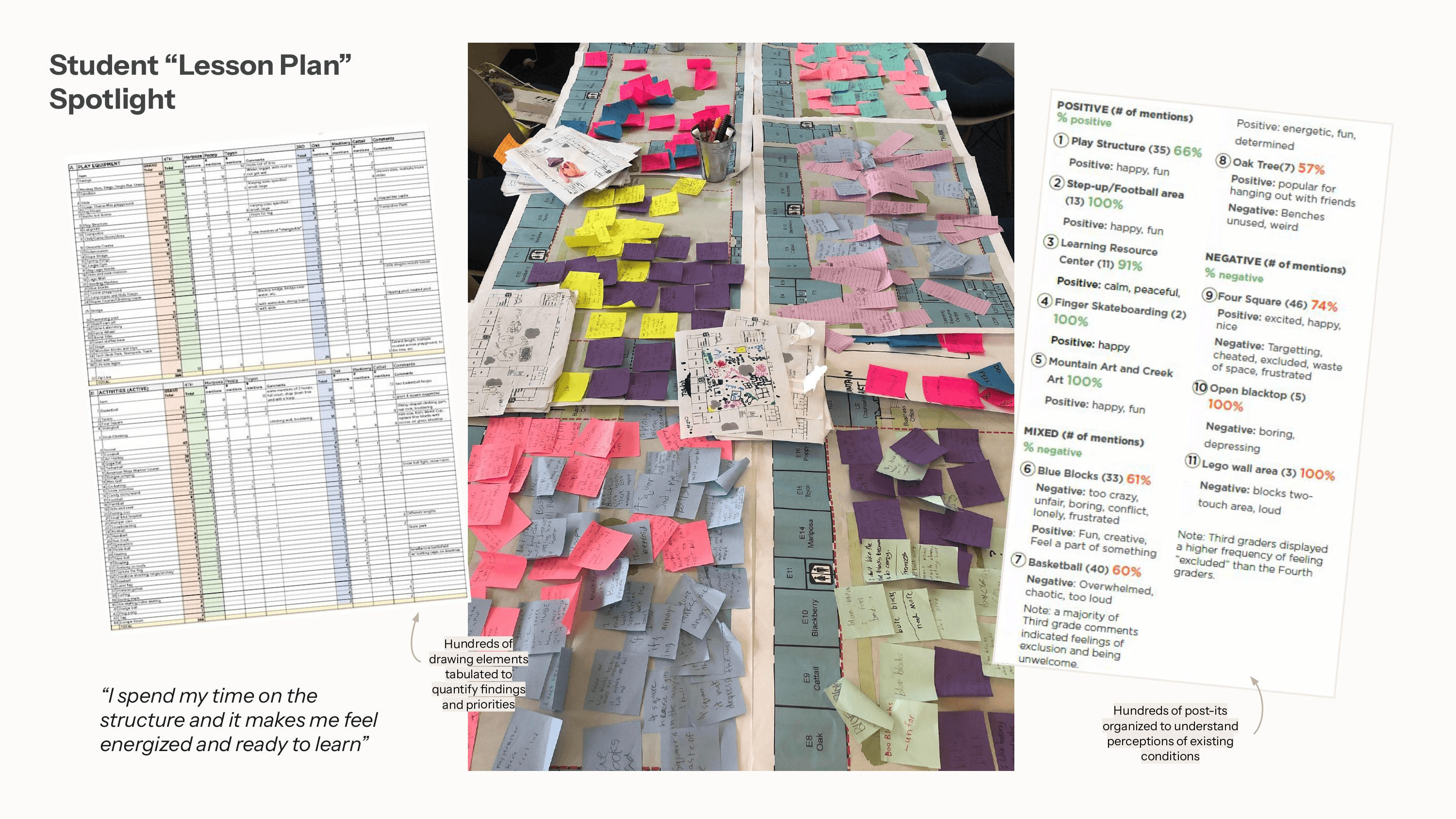
We intentionally built a week-long design thinking lesson plan that faculty delivered as part of class time. Students mapped "The Now" with post-its showing what they liked, avoided, and how each area made them feel, then drew a "Wishful Future" in two sessions, one indoors and one on site so they could judge scale. Students learned a design process while giving us the input we needed

02
Hundreds of post-its and drawings were tabulated
Quantifying student comments surfaced things observation missed. Four square drew 74% negative mentions, basketball 60%, with students describing exclusion and feeling overwhelmed. Third graders reported exclusion more often than fourth graders

03
Faculty were engaged separately
Twenty faculty went through their own visioning workshop. Where their priorities diverged from the students', the design had to hold both, producing five distinct play zones rather than one open field
The framework for play and conceptual design was delivered in early 2020. Future project phases were indefinitely paused due to the pandemic
Say hello. Let's make magic ↗
← Back